
Gods of Plinko Demo Review
Gods of Plinko by 100HP Gaming turns the standard Plinko formula into a mythology-themed clash between Zeus and Hades. Instead of a plain drop board, the game builds tension through side-based multipliers, progress bars, bonus boosts, and rapid multi-ball play.
With a 97% RTP, bets ranging from $0.01 to $1,500, multipliers up to x1000, and support for both desktop and mobile play, Gods of Plinko is designed for players who want something faster and more theatrical than a basic ball-drop game.
Quick Facts
| Feature | Details |
|---|---|
| Provider | 100HP Gaming |
| Release Date | 16.10.2025 |
| RTP | 97% |
| Volatility | Medium |
| Min Bet | $0.01 |
| Max Bet | $1,500 |
| Maximum Win | $10,000 |
| Top Multiplier | x1000 |
| Demo Mode | Yes |
| Platforms | Web, Android, iOS |
| Technology | HTML5, JS |
What Gods of Plinko Is
Gods of Plinko is a fast-paced Plinko-style casino game built around a mythological rivalry. Zeus controls one side of the board, Hades commands the other, and every ball drop contributes to a running battle between the two gods. Rather than relying only on static multipliers, the game introduces momentum through progress bars and temporary power boosts.
This makes the experience feel more dynamic than a standard Plinko board. Each session is still driven by chance, but the presentation and side mechanics add more tension and visual identity than many competing releases in the genre.
Theme and Visual Style
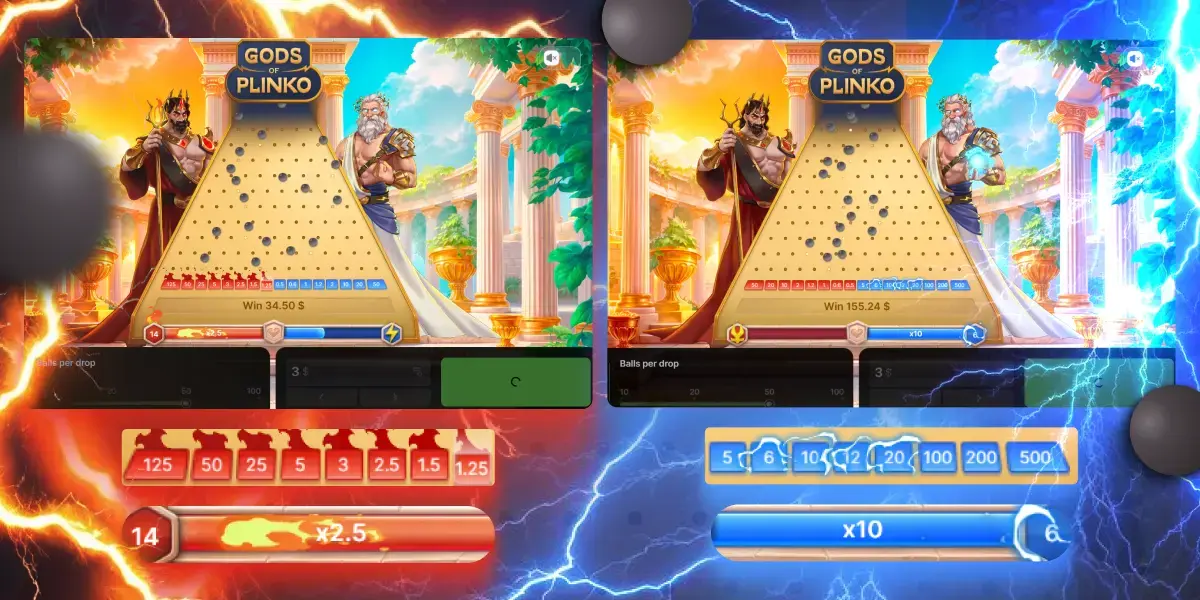
The visual concept is built around a split divine battlefield. Zeus’s half uses gold accents, bright blues, and lightning effects, while Hades is represented through darker reds, fire, and underworld-style tones. This contrast gives the interface a strong two-sided personality from the first drop.
The board is not treated like a neutral mechanical surface. Instead, the UI reacts to whichever god is gaining momentum, with atmospheric effects that make the session feel more animated and alive. That extra visual movement helps the game stand out in a genre that can often look very minimal.
The strongest design idea in Gods of Plinko is simple: it turns a math-driven drop board into a dramatic conflict between two forces, which makes every bounce feel more eventful.
How the Game Works
The basic structure is easy to understand. You choose your stake, decide how many balls to launch, and then let them fall through the peg board toward a multiplier zone. Where each ball lands determines the payout for that drop.
The game supports anywhere from 1 to 100 balls per round, which gives players flexibility in how calm or chaotic they want the session to feel. You can test the board slowly with one ball at a time, or push the pace by launching large batches to create more immediate volatility at Lucky Vibe Casino.
- Pick your base bet amount
- Choose how many balls to launch
- Drop the balls and watch them bounce across the board
- Collect payouts based on the multiplier each ball hits
- Fill Zeus or Hades progress bars to activate boosted phases
Multipliers Explained
Every ball in Gods of Plinko lands on a multiplier, and those values range from very small returns up to much stronger hits. The game uses a spread that balances common low-to-mid outcomes with rarer high-end results.
The published multiplier table shows that the most frequent outcomes sit near the lower end, while larger rewards become sharply less likely as the values rise. That creates a structure where the game feels active enough to keep moving, but still leaves room for occasional explosive moments.
| Multiplier | Chance (%) |
|---|---|
| 0.5x | 19.64 |
| 0.6x | 15.27 |
| 1x | 9.16 |
| 1.2x | 4.16 |
| 2x | 1.39 |
| 10x | 0.32 |
| 20x | 0.05 |
| 50x | 0.003 |
On paper, the largest multiplier potential reaches x1000, which is where the game’s headline win potential comes from. However, those top-end outcomes are obviously meant to be rare and should be seen as exceptional rather than routine.
Zeus vs Hades Mechanic
The feature that gives the game its identity is the conflict between Zeus and Hades. The board is split into two halves, and every ball contributes energy to one side depending on where it lands and how strong the resulting multiplier is.
As the round continues, each god’s progress bar fills. Once a bar reaches its threshold, that side enters a boosted state:
- Zeus bonus: multipliers on Zeus’s side are boosted by x10
- Hades bonus: multipliers on Hades’s side are boosted by x2.5
These boosted states stay active for a limited number of balls before the board resets to normal. In some cases, both gods can activate during the same overall sequence, which creates a more chaotic and rewarding-looking board state.
Progress Bars and Bonus Flow
Progress bars are not just decorative. They create a sense of accumulation and momentum that changes how players read each drop. A stronger multiplier contributes more energy than a smaller one, so big hits help push a god toward activation much faster.
Another important detail is that progress is linked to the selected stake level. Changing the bet does not erase the game’s logic entirely, but it does separate your visible accumulation path, which means consistency matters if you are trying to grind toward one side’s bonus.
During an active bonus phase, the bars pause until the effect ends. This keeps the feature structure cleaner and prevents overlapping buildup from becoming confusing.
Gods of Plinko feels more engaging than a basic drop game because it rewards not only single hits, but also sustained momentum toward a side-based power phase.
Balls Per Drop and Session Intensity
One of the simplest but most useful controls in the game is the number of balls you can launch per round. Instead of being limited to a single drop, you can scale the action significantly by selecting higher batch counts.
Low-volume play
Dropping 1 or a small number of balls makes it easier to observe the board, follow the progress bars, and understand how the modifiers behave without rushing through the session.
High-volume play
Launching 10, 20, 50, or 100 balls speeds everything up, fills bars more aggressively, and makes the session feel louder, faster, and more volatile.
The total stake scales automatically based on the number of balls chosen, so higher drop counts increase exposure even if the base bet remains unchanged.
RTP, Volatility, and Max Win
Gods of Plinko runs with a listed RTP of 97%, which is strong for this kind of fast-action title. The game is described as having medium volatility, suggesting that it aims for a more balanced rhythm than ultra-volatile crash or extreme multiplier formats.
The top potential win is shown as $10,000 per ball, with the maximum multiplier reaching x1000. That gives the game enough headline upside to stay exciting without forcing every session into an all-or-nothing structure.
| Metric | Value | Meaning |
|---|---|---|
| RTP | 97% | Above-average return profile for long-term play |
| Volatility | Medium | Less punishing than the wildest multiplier formats |
| Top Multiplier | x1000 | High ceiling with rare premium outcomes |
| Maximum Win | $10,000 | Strong upper limit for a Plinko-style game |
Demo Mode and Why It Matters
The demo version of Gods of Plinko is useful because it removes bankroll pressure and allows full experimentation with the game’s structure. You can test low-risk play, aggressive multi-ball sessions, and both Zeus and Hades progress paths without losing real funds.
This matters especially in a game where pace can change dramatically depending on how many balls you launch. Demo play gives you time to understand the board before taking the same decisions with real money.
Mobile App and Device Support
Gods of Plinko is available across web, Android, and iOS, and the game is also presented as a dedicated app experience. The mobile version keeps the key systems intact, including the progress bars, side-based boosts, and turbo-friendly gameplay flow.
According to the available specifications, the app is built for relatively modern devices without demanding huge storage requirements. That makes it accessible for players who want to move between desktop and mobile sessions without losing the game’s main functionality.
| Requirement | Android | iOS |
|---|---|---|
| OS Version | Android 8.0+ | iOS 12.0+ |
| Storage | 80 MB | 90 MB |
| RAM | 2 GB minimum | 2 GB minimum |
| Internet | Stable 3G / 4G / 5G | Stable 3G / 4G / 5G |
| CPU | Snapdragon 665+ | A10 Fusion or newer |
Pros and Cons
Pros
- 97% RTP gives the game a solid long-term return profile
- Zeus vs Hades mechanic adds more identity than standard Plinko titles
- Flexible ball counts support both slow testing and high-speed play
- Strong visual theme with reactive UI and clear side-based tension
- Available on web and mobile platforms
Cons
- High-end multiplier outcomes remain rare by design
- Progress tracking becomes less straightforward when changing bet size
- No autoplay means all rounds still require manual interaction
Final Verdict
Gods of Plinko is more than a simple ball-drop game dressed up with mythological art. Its real strength comes from how it combines multipliers, side-based progression, and temporary god-powered boosts into a structure that feels more active and theatrical than many standard Plinko releases.
The game benefits from a strong 97% RTP, a generous betting range, flexible drop settings, and a concept that remains easy to understand despite having more moving parts than average. For players who want a faster, more stylized Plinko experience with real momentum behind each session, Gods of Plinko is definitely worth testing in demo mode first.